


Key Takeaways
- USTC launched Jiuzhang 4.0, manipulating 3,050 photons to reach 92% source efficiency in quantum computing.
- Lu says Jiuzhang 4.0 processes data in 25 microseconds, disrupting the industry’s classic supercomputers.
- Bitcoin developers must address this rising quantum threat, weighing fixes like BIP-360 to secure data.
China’s Jiuzhang 4.0 Photonic Quantum Computer Breaks Records
China has cemented its leadership in the quantum computing world with Jiuzhang 4.0, the latest iteration of the nation’s take on quantum computing that leverages photons to make advanced calculations.
According to Nature, Jiuzhang 4.0 achieved a breakthrough in the sector, increasing the number of photons manipulated to 3,050, up from the 255 mark achieved with Jiuzhang 3.0 in 2023.
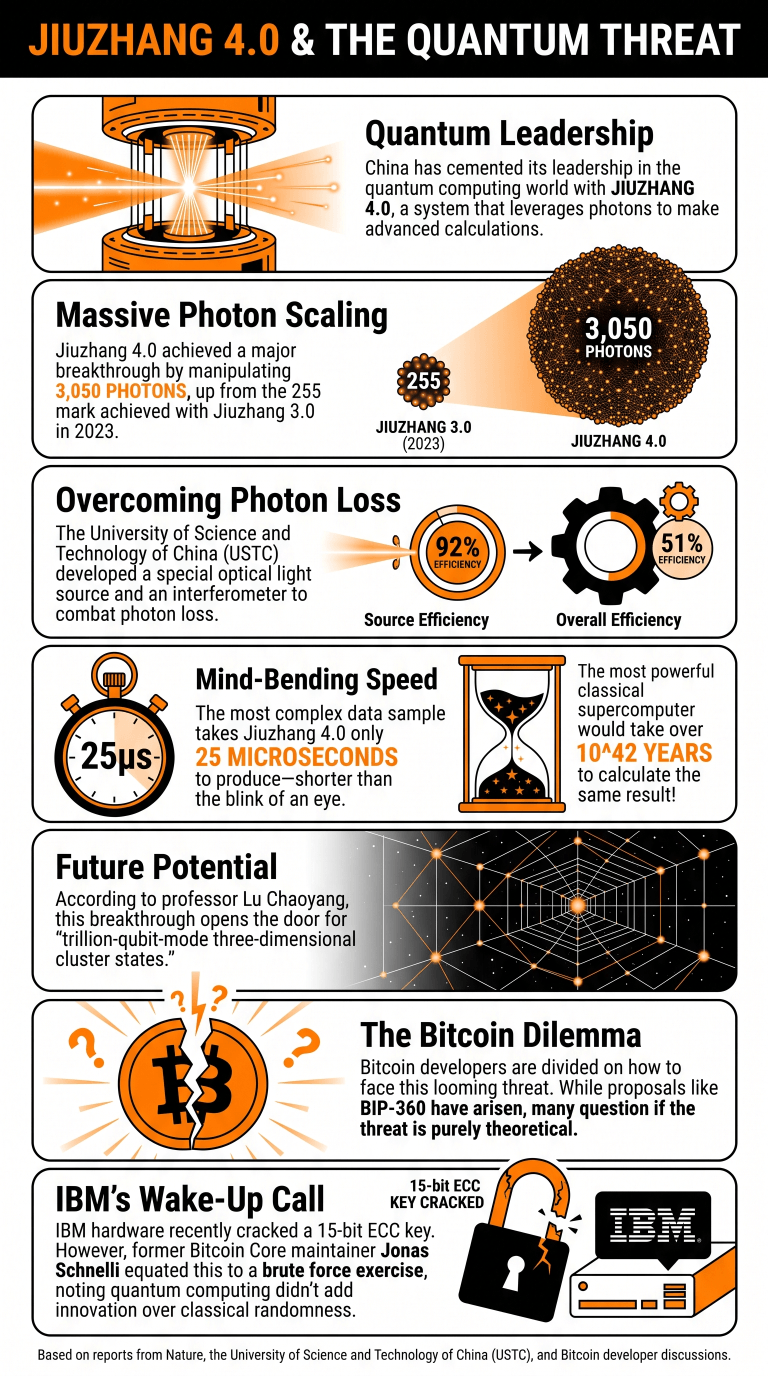
While the development of photonic quantum computers has been hampered by photon loss, the University of Science and Technology of China (USTC) developed a special optical light source and an interferometer that allowed the system to increase its source efficiency to 92% and its overall efficiency to 51%.
Lu Chaoyang, a professor at the USTC, stated that “the most complex data sample generated by ‘Jiuzhang 4.0’ takes only 25 microseconds to produce – shorter than the blink of an eye.” This shows a remarkable improvement compared to the most powerful computer in the world, which would take “more than 10 to the 42nd years to calculate the same result,” said Lu.
Lu highlighted that this manufacturing breakthrough opens the possibility to further advance photonic quantum computing development, enabling the construction of “trillion-qubit-mode three-dimensional cluster states.”
While quantum computing is rapidly advancing, Bitcoin developers have yet to determine how they will prepare and face this looming threat. While several proposals have arisen, including BIP-360, the community is divided on the timing and relevance of the fix, with many questioning the quantum threat as purely theoretical.
Recently, the bitcoin community also faced a wake-up call, as IBM hardware cracked a 15-bit ECC key. Nonetheless, some developers equated this to a brute force exercise. Former Bitcoin Core maintainer Jonas Schnelli analyzed the event and explained that quantum computing did not add anything more innovative over classical randomness.

Other Articles

This Indicator Correctly Called Major Ethereum Moves





No Comment! Be the first one.